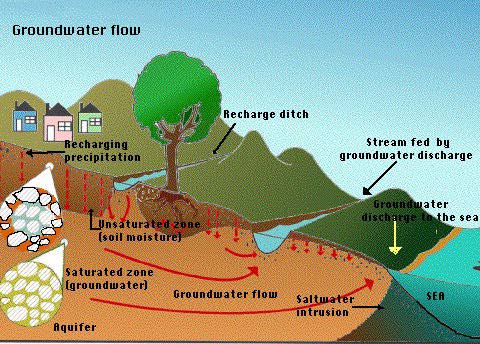
Aquifers are layers of water
saturated soil or rock with spaces that allow water to move through it.
Groundwater flow rate depends on the size of the
spaces in the soil and rock and how well the spaces are connected. Areas
where water fills the groundwater aquifers is called the saturated zone.
> ground water aquifers yield water of
usable quantity to wells and springs.
>low permeability clay-rich glacial deposits and shale do not conduct
water
> instead they act as confining beds
> aquifers are like pipes or conduits that conduct water between confining
beds
> groundwater generally moves very slowly and follows the least resistive
(most permeable) pathway from the point of recharge (where water
enters the aquifer) to the point of discharge (where water leaves
the aquifer)
> shallow groundwater generally moves at rates up to
one meter per day or greater
> aquifers that have conduit-like openings, such as basalt and
karstic (cavernous) limestone, move much faster
> deeply circulating groundwater moves extremely slowly—sometimes
as little as a meter or less per century.
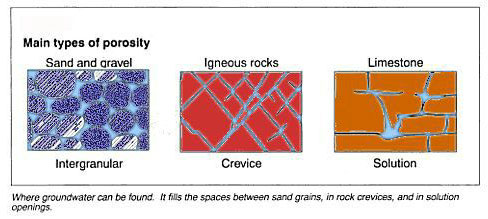
Porosity of Aquifer Substrate
Sand and gravel - the
intergranular spaces of sand and gravel provide an excellent substrate for
ground water and makes an excellent compound for well drilling
Igneous Rock - unless the igneous rock substrate is
fractured due to cooling or shearing forces the igneous rock makes a poor
aquifer
Limestone Rock - made from old reefs and other animal sources of
calcium carbonate make great aquifers and because of high solubility may
form large underground rivers and lakes!
Imagine throwing sand and gravel into your swimming pool.
This would be an aquifer! The walls or liner would be the aqualude.
|