| |
| VOL. 23, NO. 11 |
DECEMBER 5, 1997 |
|
Lamont's Broecker Warns Gases Could Alter Climate
Oceans' Circulation Could Collapse
BY LAURENCE LIPPSETT
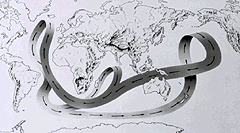 |
| Thermohaline
circulation links the Earth's oceans. Cold, dense, salty
water from the North Atlantic sinks into the deep and
drives the circulation like a giant plunger. |
|
 n the eve of
the international meeting on global warming that opened Dec. 1 in
Kyoto, Japan, one of the world's leading climate experts warned of
an underestimated threat posed by the buildup of greenhouse
gases—an abrupt collapse of the oceans' prevailing circulation
system that could send temperatures across Europe plummeting in a
span of 10 years. n the eve of
the international meeting on global warming that opened Dec. 1 in
Kyoto, Japan, one of the world's leading climate experts warned of
an underestimated threat posed by the buildup of greenhouse
gases—an abrupt collapse of the oceans' prevailing circulation
system that could send temperatures across Europe plummeting in a
span of 10 years.
If that system shut down today, winter temperatures in the North
Atlantic region would fall by 20 or more degrees Fahrenheit
within 10 years. Dublin would acquire the climate of Spitsbergen,
600 miles north of the Arctic Circle.
"The consequences could be devastating," said Wallace S.
Broecker, Newberry Professor of Earth and Environmental Sciences
at Columbia's Lamont-Doherty Earth Observatory, and author of the
new research, which appeared in the Nov. 28 issue of the magazine
Science.
A complex of globally interconnected ocean currents,
collectively known as the Conveyor, governs our climate by
transporting heat and moisture around the planet. But the Conveyor
is delicately balanced and vulnerable, and it has shut down or
changed direction many times in Earth's history, Broecker reports.
Each time the Conveyor has shifted gears, it has caused
significant global temperature changes within decades, as well as
large-scale wind shifts, dramatic fluctuations in atmospheric dust
levels, glacial advances or retreats and other changes over many
regions of the Earth, he said.
The Conveyor "is the Achilles heel of the climate system,"
Broecker wrote in Science. "The record ... indicates that
this current has not run steadily, but jumped from one mode of
operation to another. The changes in climate associated with these
jumps have now been shown to be large, abrupt and global."
The ongoing accumulation of heat-trapping industrial gases
blanketing the Earth threatens to raise global temperatures, he
said, but such a rise would occur gradually. Far more worrisome is
the buildup's potential to stress the climate system past a
crucial threshold that would disrupt the Conveyor and set off a
rapid reconfiguration of Earth's climate, predicted by existing
computer models.
Broecker also offered a new theory: Scientists generally
agree that periodic changes in Earth's orbit and the amount of
solar radiation it receives have paced fundamental climate changes
on the planet over millions of years. But the global climatic
flip-flops may have been set in motion by sudden switches in the
operation of the Conveyor.
Today, the driving force of the Conveyor is the cold, salty
water of the North Atlantic Ocean. Such water is more dense than
warm, fresh water and hence sinks to the ocean bottom, pushing
water through the world's oceans like a great plunger. The volume
of this deep undersea current is 16 times greater than the flow of
all the world's rivers combined, Broecker said, and it runs
southward all the way to the southern tip of Africa, where it
joins a watery raceway that circles Antarctica. Here the Conveyor
is recharged by cold, salty water created by the formation of
sea ice, which leaves salt behind when it freezes. This
renewed sinking shoves water back northward, where it gradually
warms again and rises to the surface in the Pacific and Indian
oceans.
In the Indian Ocean, surface waters are too warm to sink.
Northern Pacific waters are cold, but not salty enough to sink
into the deep. This is primarily because prevailing winds that
whip around the planet hit the great mountains of the western
United States and Canada and drop their moisture. The resulting
snow and rain runs into the Pacific, adding a dose of fresh water
that dilutes the Pacific's saltiness, said Broecker
Today, the Conveyor comes full circle, eventually propelling
warm surface waters, including the Gulf Stream, back into the
North Atlantic. In winter, warm water transfers its heat to the
frigid overlying air masses that come off ice-covered Canada,
Greenland and Iceland. The eastward-moving air masses make
northern Europe warmer in winter than comparable latitudes in
North America. Without the Gulf Stream, nothing would temper the
Arctic air, and Europe would enter a deep freeze.
|